Design
Architecture
See the corresponding architecture from the "Getting Started" section.
SQL MI datacenter location
The following datacenter locations are available for the SQL MI deployment:
- West Europe
- East US 2
Define the closest location to the customer's Webex datacenter.
Shared vs. Dedicated Instance
The design of the SQL MI depends on the required features and usage of CCBI.
CCBI on shared instances (SI) is limited to historical data and Intraday reports but pricing wise the cheapest option for small systems.
If real time reporting or extensive refreshes are required, a deployment on a dedicated instance (DI) is necessary. For this kind of deployment, the minimum subscription of named users or concurrent agents is higher than for a shared instance because of the initial costs for the smallest instance capacity.
Service Availability
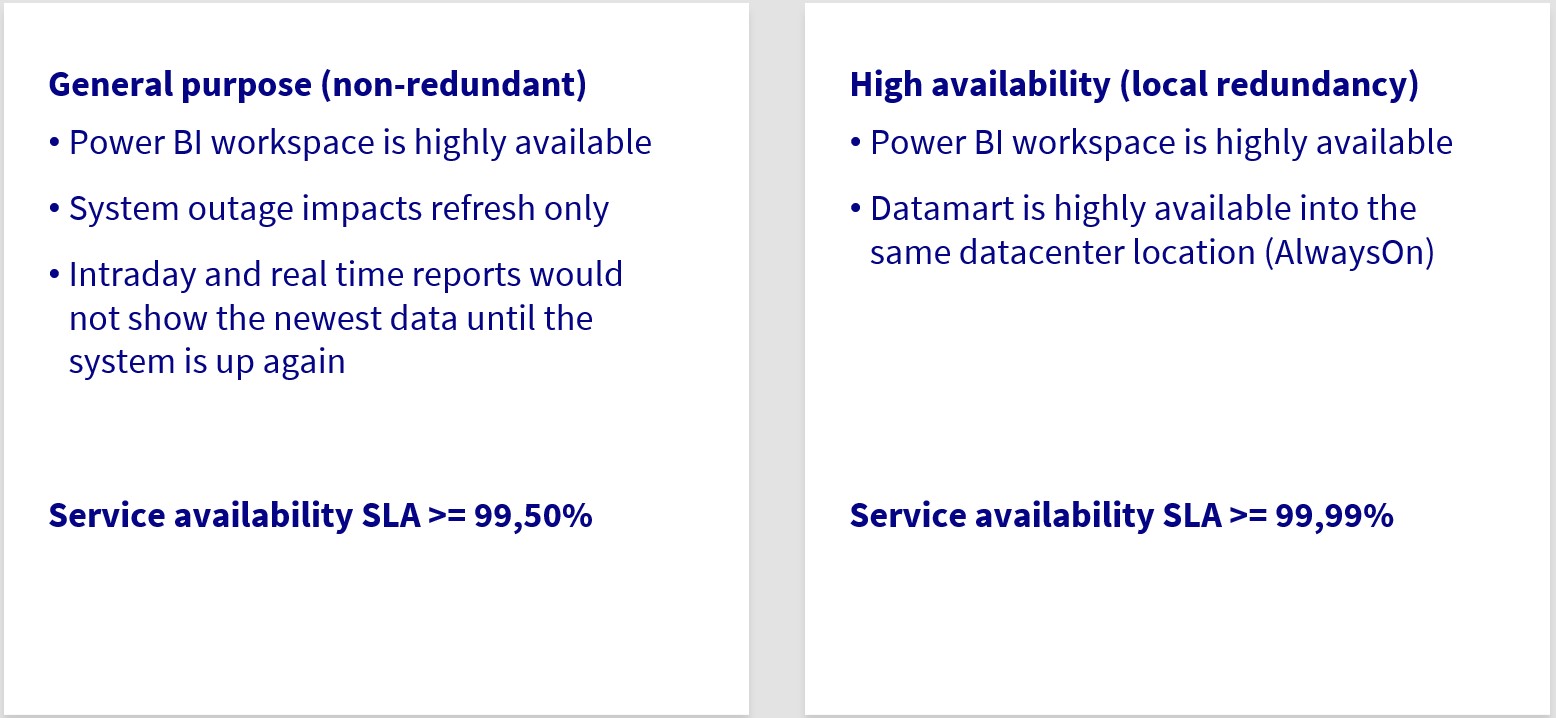
The solution within the Power BI service is highly available, independent of the SQL MI datamart availability. Any service interruption of the SQL MI would only affect the incremental refresh of new data.
For the shared and the dedicated instance service, there are the following subscriptions available:
Data retention time
Data is stored for 3 years (1095 days exactly) in the datamart and will be deleted after this time without any notice.
If data must be kept for a longer period, customers must request this and will get the offering for increased storage space on top of the existing service subscription.
Available time zones
Data is stored in UTC and converted to the time zone that is selected by the user. Next to UTC, there has to be at least one other time zone enabled in the system. Keep the list of available time zones as little as possible because users must choose the right time zone from that list and every time zone has some impact to the performance.
See the list of supported time zones
Global Variables
Up to 10 reportable variables can be included within the facts and dimensions of the semantic model. We need to map the available variables to a fixed variable name (VARIABLE 10 to 20) inside the data model because the name of the variables differs in every system.
Simply define which global variables should be mapped to number 10 to 20.